
Carl Sagan’s Cosmos came out while I was an atheist, and I thought it was a wonderful TV series. I loved the state-of-the-art graphics, and, of course, Sagan was a master documentarian. I know now that there was quite a bit of anti-religious propaganda in the script, but at the time it didn’t bother me, because, well, I was an atheist, so I didn’t notice it, and it wouldn’t have bothered me if I had noticed it. I believe it was quite mild compared to the in-your face anti-theism so prevalent today.
In fact, when Neil deGrasse Tyson announced he was doing a remake, I thought it was quite exciting. There was certainly plenty of new science in astronomy and cosmology to catch up on. This time, though, as a Christian I was keenly aware of the potshots and distortions of history and theology that were beamed out to the public in the name of science.
But my goal is not to review the Cosmos TV show. Instead, I want to discuss a new book recently published that is a marvelous antidote and a gentle rebuttal to the tone of Cosmos. The book is called The Story of the Cosmos, edited by Daniel Ray (an online friend) and Paul Gould. The chapters are all about cosmology, astronomy and related sciences, but there is not much about biochemistry, so I read it as an educated layman.
The Story of the Cosmos is a joy to read. The quality of the writing and the impeccable scientific content of the essays make this book a wonderful counter-argument to the Sagan/Tyson narrative of a meaningless, purposeless, Godless cosmos. The individual authors, all expert authorities in their fields, tackle subjects as diverse as black holes, fine-tuning, binary stars, meteorites, and the history and literature of the scientific study of the universe, all from a Christian theistic worldview. This book is all about declaring the glory of God by studying the heavens.
As would be expected, the different authors employ a variety of styles in their chapters, but all of them are eminently readable for the non-specialist (like me) and full of interest and insights. Educational and entertaining, this book would make a marvelous gift for a student of any age who is interested in learning about the science of cosmology without the tired anti-religious propaganda that pervades so much of popular scientific literature and media.
While I found every chapter to be intriguing and informative, I especially enjoyed Consolmagno’s humble and straightforward accounts of his laboratory work on meteors, Salviander’s story of black hole denialism, and Gonzalez’ treatment of a subject of great interest to me–exoplanets and astrobiology. William Lane Craig, the famous apologist, theologian, and philosopher, has an outstanding chapter that summarizes many of his familiar apologetic arguments and goes into new areas stimulated by newer findings. The other chapters are equally beautifully written and interesting, and you might be hard pressed to choose your own favorites. Congratulations to editors Daniel Ray and Paul Gould for a magnificent job on this volume, which I believe will be essential reading for anyone interested in science and Christian faith.
I originally intended to post a review on the book’s Amazon page, but I was prevented from doing so. Apparently, something in my profile triggered a rejection of my review, because it reflected information in another reviewer’s profile. Huh? After a few attempts to correct this error, Amazon basically told me that the decision stands. The good news is that the book is selling well, despite the lack of a review from me. Here is the link to the Amazon page for ordering the book, or, of course, you could patronize your local bookstore. Either way, I strongly recommend obtaining a copy. It’s a great reference, and a pleasure to read. Order it here.
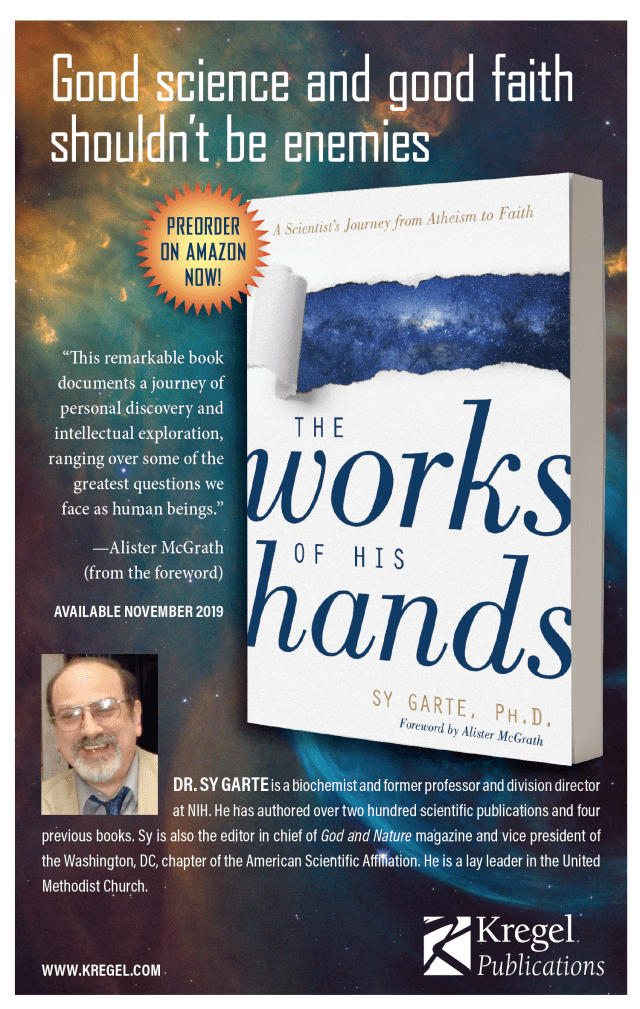


 The Book of Works